This year marks my fourth participation in an Open Science retreat. I started writing this blog with a post on Open Science, and it is time to continue blogging. Why not share my reflections on the Open Science retreats I’ve attended? Rest assured, there is more in the pipeline, as well as more technical content.
Going to this year’s Open Science retreat has been really special for me. First, because my son (14) accompanied me all the way to Wales by train, which was a little adventure in itself. And second because I had no idea at the time whether I would have to leave academia altogether.
Ordinarily, you are somewhere in the academic hierarchy and if you’re not a professor you have to justify every trip to a conference. Are you going to present a poster? Or give a talk? This time, it felt more like a one-week holiday — and the overlap with school holidays made it especially convenient and welcome1. Of course, neither my institution nor I saw immediate benefits. Or did we? — This is the question, whether academic institutions who pay lip service to Open Science should grant such opportunities?
There’s a reason I’ve gone four times now. Apart from meeting all the lovely people, I mean. And this is to explore ideas beyond the usual! Yes, Open Science in itself is important. What, specifically, do you gain from an “unconference”?
Two years ago, for example, I was introduced to Nanopublications. This time around, we published an introductory onboarding guide for nanopubs. More recently, I published a Snakemake plugin for better software provenance using nanopubs. All this has nothing to do with my job — and yet, it has everything to do with it2! So we have something tangible for my institution. But there are more, softer, less tangible outcomes from such retreats. Every year we publish a collection on ResearchEquals. Nice, isn’t it?
My work feels meaningful to me — I hope you feel the same. Yet, there are more important things than “tangible outcomes” — for instance, being able to start your work each day without fear. Anticipating pleasant interactions is even better. Such a retreat offers the chance to recharge, meet new people from around the world, and be introduced to their research. I’ve made friends across Europe and beyond.
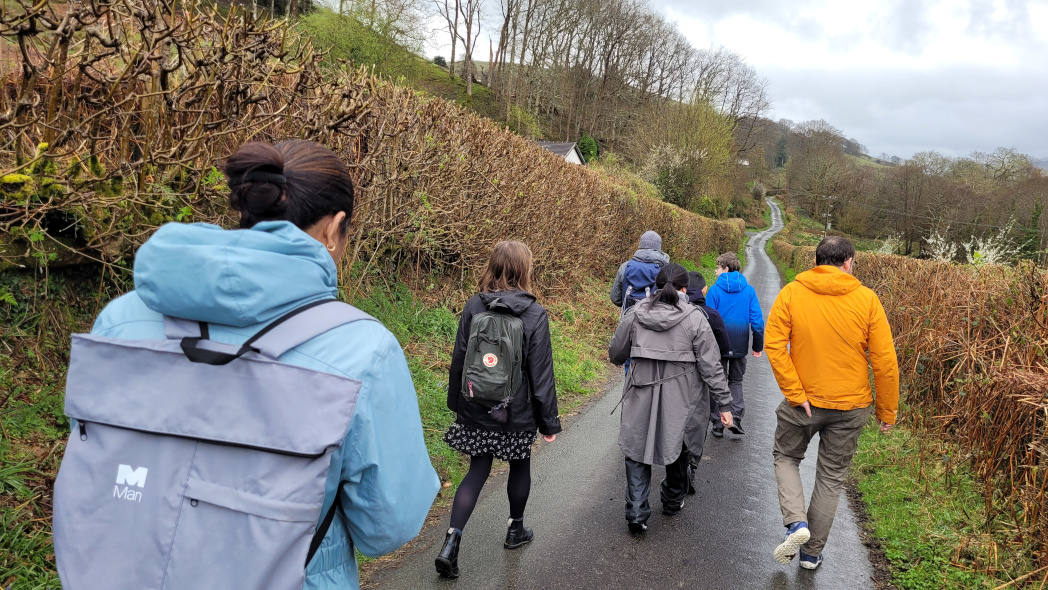
This time in March at Machynlleth3 I almost cried when saying goodbye (you see some of us hiking towards the town. I am the one with the grey tuque on the left.) Not knowing whether I could stay in academia, I also didn’t know whether I’d have a chance seeing many again4. This is why I want to stay in academia: to make a difference and stay connected. There is a life beyond work, but work without colleagues who strive to remain decent, is not worth once’s lifetime5.
- Disclaimer: I really took a week off from work. ↩︎
- My idea is to develop a workshop around the plugin which builds on top of teaching reproducible workflow execution on HPC clusters (HPC = High Performance Computing, a.k.a. „supercomputers“). Certainly, software provenance is a topic in my field. ↩︎
- I really tried to pronounce that place and a few phrases. Until I heard a few locals say it. Well, Welsh is a charming language and linguistically fascinating. It is just that I did not make a good job trying … ↩︎
- Suffice to say, that I will be on a long leave from my uni and that I will be working and will continue my work at Frankfurt’s HPC group — for this opportunity I am most grateful. Yet, the deal is that I say no more. ↩︎
- This, at least, is my personal account. Allow me yet another footnote to write what my son thought to be particularly valuable: Guided tours to learn something about sustainable architecture. A program for kids, so that we “old ones” can bring our family. And a location sample impressions, particularly from other cultures. I can only second his view. ↩︎
Schreibe einen Kommentar